The Modern Mockup: How Top-Tier Web Developers Create and Present Designs
“They don’t make them like they used to.” We’ve all heard it, a nostalgic nod to the “good old days.” But when it comes to web design, the old ways weren’t necessarily better. In fact, the way designers create and present mockups has evolved dramatically, becoming faster, more collaborative, and far more effective.
Let’s look at how the web design mockup process has transformed, from the early Photoshop days to today’s cloud-based, interactive and AI driven workflows.
How It Started: The Old Way of Designing Websites
Before tools like Figma, Framer, Uzard and Ai assistance, web designers relied almost entirely on Adobe Photoshop. It was powerful for image editing, but cumbersome for designing full websites. Each page of a site typically lived in its own large .psd file, for example: Home-Page.psd, About-Us.psd, Services.psd, and so on.
That workflow came with serious challenges:
- Time-consuming updates: Want to change a button color across the site? You had to open and edit every file manually.
- Version control chaos: To avoid overwriting files, designers saved endless revisions in separate files such as homepage-final-3b.psd, homepage-final-FINAL.psd, and so on.
- No interactivity: Flat image mockups couldn’t show hover states, scrolling behavior, or animations.
- Inefficient client feedback: Clients could only review static images, often sending feedback via long emails or marked-up PDFs.
- Tedious handoff: Exporting individual assets, packaging them, and explaining how to use them took hours.
While this process produced beautiful designs, it was slow, inefficient, and prone to error.
How It’s Going: Better Tools for Better Web Design
Today, the mockup process looks entirely different and far more streamlined.
At Airtight Design, our preferred tool is Figma due to its emphasis on real-time collaboration. But whether you use Figma, Framer, Uzard, or Ai assistance, modern prototyping tools have revolutionized web design.
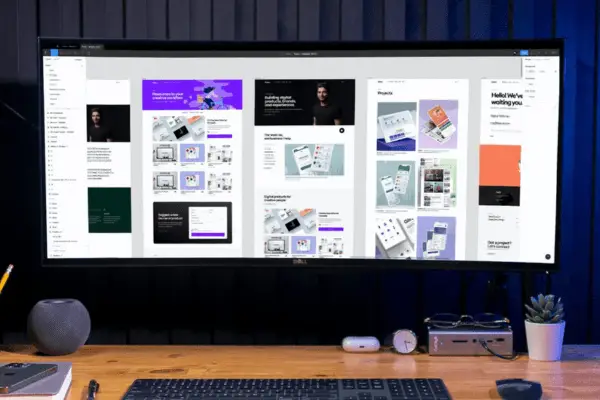
Here’s how: 1. One File, Multiple Artboards Designers now work from a single file containing multiple artboards, allowing easy organization and quick sharing. You can send clients a link to view all or select screens instantly in a browser. 2. Interactive Prototypes Modern mockups aren’t static images, they’re fully interactive. Designers can demonstrate:
- Hover states
- Scroll animations
- Clickable navigation
- Transitions and motion effects
This helps clients visualize the final user experience before a single line of code is written.
3. Real-Time Collaboration Because everything lives in the cloud, multiple designers, and even clients, can collaborate in real time. Edits, comments, and version history are automatically saved, eliminating messy file versions like “Homepage-Final-7-No-Really-This-Time.psd.”
4. Global Style Updates With shared asset libraries, a single color, font, or button style changes update across every instance in seconds. No more manual edits across dozens of files.
5. Seamless Developer Handoff Once the design is approved, handoff is effortless. Designers simply tag assets and share a “Development” link. Developers can download everything they need (images, icons, hex codes, and even auto-generated code snippets) directly from the shared file.
Why It Matters
Modern design tools have eliminated many of the pain points that once made web mockups time-consuming and inconsistent. The result is a workflow that’s:
- Faster: Centralized files and reusable components streamline every step.
- Smarter: Real-time feedback and version control keep teams aligned.
- More collaborative: Cloud-based sharing enables seamless teamwork between designers, developers, and clients.
- More accurate: Interactive prototypes reduce miscommunication and help clients visualize the end product.
As web design technology continues to advance, these improvements empower designers to focus on what matters most: creating exceptional digital experiences.
The Future of Web Mockups
With tools like Figma and Framer evolving rapidly, the web design process will only become more efficient and connected. At Airtight Design, we embrace these innovations to deliver visually stunning, technically sound, and conversion-driven websites for our clients. From AI-assisted layouts to automated responsiveness, the next generation of design tools will continue to push creative boundaries.