I Fixed My Furnace with AI. That's an $18 Billion Reality Check.
My propane tank ran dry — my fault, I should have been watching the gauge. I refilled it. The furnace didn't come back on.
Normally, this is a service call. I'd phone my HVAC company, wait for a tech, and pay $85 to $150 for a diagnosis and fix. Instead, I opened Claude — Anthropic's AI assistant — uploaded a photo of my furnace's rating plate, and described the problem.
Claude identified my unit — a Lennox SL280 — and diagnosed the most likely issue: air trapped in the gas line after the tank ran empty. It walked me through the reset. When that didn't work, I reported two fault codes flashing on the control board. Claude told me a safety switch called a rollout had tripped — a $4 part doing exactly what it was designed to do — and showed me where to find it.
A rollout switch trips because flame escaped the combustion chamber. That can mean something serious — a cracked heat exchanger, a blocked flue. But I had context Claude didn't: the gas company had told me I'd need to relight the furnace after the refill, and I knew the tank had just been completely empty — because I was the one who let it run dry. There was no mystery about why the burner misfired. If the tank hadn't literally just run dry, I would have had a lot more hesitation about pressing a reset button on a combustion safety switch — and probably would have called a tech. That judgment call was mine, not the AI's. AI didn't replace the tech. It gave me enough to decide I didn't need one.
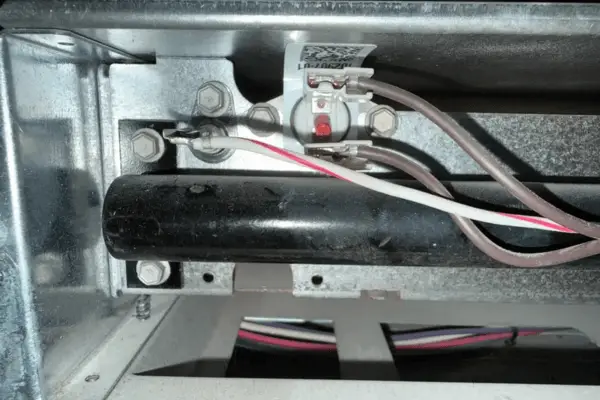
I sent photos of the furnace interior. Claude labeled components in my images, told me which panel to remove, confirmed I should kill power first, and guided me to two small disc switches with red reset buttons. I found them — but before I touched anything, I took a close-up photo and sent it back. "Is this the red button you're talking about?" Claude confirmed. I pressed it. It clicked. I restored power. The furnace fired.
Total time from dead furnace to warm house: less than I'd have spent on hold scheduling the appointment.
That knowledge gap — the one between "I see a problem" and "I know how to fix it" — is what the service call monetizes. AI just closed it in a conversation.
This won't always work. AI models can hallucinate components, misidentify failure modes, or miss context that a tech on site would catch immediately. My case was straightforward — a known cause, a visible symptom, a simple reset. If the AI had been wrong, I'd have called a tech anyway. But that's the point: the easy calls get filtered out, and the hard ones still need a professional.
The Revenue at Risk
If you run a service business, that call I didn't make is your revenue.
HVAC service and maintenance alone is an $18 billion industry in the US — with residential making up over half.1 Of the service calls that are actual breakdowns — not scheduled maintenance — industry estimates suggest nearly 70% are preventable with routine upkeep.2 Dirty filters, tripped switches, thermostat issues, clogged drains — problems that take longer to drive to than to fix. Not all of those are problems a homeowner can fix after the fact — but a meaningful share are, and those are the ones AI puts within reach. Every one of those calls a homeowner resolves with AI is revenue that disappears.
The same applies to any service industry where the real value of the call is the diagnosis, not the physical labor. Automotive. Plumbing. Electrical. Appliance repair. IT support. In all of them, a large share of paid calls are for problems that are simple to fix but impossible for the customer to diagnose alone. AI doesn't need to swing a wrench to disrupt that. It just needs to tell the customer which wrench to swing.
The vulnerable revenue isn't the complex work. It's the simple work that's been priced like complex work because the customer couldn't tell the difference. AI makes the difference obvious.
The natural objection is that most people won't crawl into a furnace compartment. That's true. But the ones who will are the same people who already watch the repair videos, read the forums, and try the troubleshooting steps before calling. AI didn't create that behavior — it just made it dramatically more effective. Either way, the calls they would have made are gone.
Why This Is Different
The information to fix my furnace existed before AI. Training manuals, forum threads, manufacturer docs — even detailed YouTube walkthroughs for specific models. Some of those are genuinely good, and they've already eaten into simple service call volume.
What didn't exist was a conversation that could look at my equipment, interpret my fault codes, and adapt its guidance in real time based on what I was seeing. A video is a broadcast — useful if your situation matches. An AI conversation is a feedback loop: show, ask, confirm, act. That's the gap it closes, and it's a bigger gap than search or video ever could.
What Smart Companies Should Do
The companies that treat this as a threat to defend against will lose. The ones that adapt have a real shot — but "deploy AI" isn't a strategy. As far as I can tell, no major HVAC company has built what I'm about to describe. That's both the risk and the opportunity.
An HVAC company builds a customer-facing diagnostic portal. A homeowner with a dead furnace enters their model number and symptoms. The system walks them through safe checks — filter, thermostat, visible error codes — and resolves the 15-minute fixes. For anything more complex, it pre-qualifies the call: the right tech gets dispatched with the right parts already on the truck. The company reduces windshield time, increases first-call resolution, and builds loyalty by being the one that didn't charge $150 to press a button.
That model raises real questions — chiefly, liability. Telemedicine faced the same issue: when a doctor diagnoses remotely and the patient acts on it, who's responsible? That industry built liability frameworks that balance access with accountability. Service companies deploying AI triage will need to do the same — drawing clear lines around what the AI handles and what gets escalated to a human.
Techs with AI diagnostics cut callbacks and time on site. Dispatchers with AI triage route the right tech to the right job. Maintenance plans using predictive data catch failures before the customer ever calls.
The companies that make it won't be the ones protecting the knowledge gap. They'll be the ones who gave it up on purpose — and competed on speed, trust, and work that actually requires a human.
The $150 service call to press a red button still exists today. But the AI doesn't need to be perfect to erode it — it just needs to be right often enough that fewer people make the call.
I know it's changed my behavior. Next up: a vent in my truck that won't blow cold. I'm not calling a mechanic first. I'm opening Claude.
If AI is already changing how your customers solve problems, your business model needs to evolve with it. Let's talk about what that looks like for your company.
Josh Kimbrel is the owner of Airtight Design, where he helps businesses navigate AI adoption.
Footnotes
Mordor Intelligence valued the US HVAC services market at $17.93 billion in 2025, with the residential segment holding 52% market share (~$9.3 billion). This figure covers service, repair, and maintenance — not equipment sales. ↩
The 70% figure is widely cited across the HVAC industry. Phil's Heating and Air attributes it to a 2024 ACHR News report. A 2025 FIELDBOSS survey of 1,000 US homeowners provides supporting context: only 32% of service calls were for actual breakdowns, while 49% were scheduled maintenance — suggesting that when something does break, it's often something basic. ↩